

The local government pay rise for 2026-27 has been agreed at 3.3% for employees covered by the NJC settlement, with effect from 1 April 2026.
Eligible employees will receive revised pay and any outstanding arrears for the relevant period. The date the money reaches your account depends on your employer’s payroll arrangements.
- Pay Increase: 3% added permanently to the relevant salary rates
- Award Period: 1 April 2026 to 31 March 2027
- Back Pay: Calculated from 1 April or the applicable employment date
- Coverage: Employees on the relevant NJC terms in England, Wales and Northern Ireland
- Scotland: Separate arrangements apply, including a 3.5% award for the relevant Scottish local government employees in 2026-27
Your individual increase will also depend on your pay point, contracted hours and any changes to your employment during the year.
Last checked: 3 September 2026
What Is The Latest Update On The Local Government Pay Rise For 2026-27?
By September 2026, the NJC pay round has concluded. The focus has moved to implementing the settlement and checking that employees receive the correct revised salary and arrears.
The National Joint Council for Local Government Services negotiates the pay framework commonly associated with Green Book employment terms. Its agreement does not set one payment date for every participating employer.
What Was Agreed And How Does It Compare With The Original Union Claim?
The joint union claim, submitted on 1 December 2025, sought at least £3,000 or 10%, whichever was greater, alongside a £15 minimum hourly rate and changes to working conditions.
The accepted award is a 3.3% increase. Employees should therefore calculate their expected pay using the agreed salary scales, rather than the original demand.
A shorter working week or additional leave should not be assumed simply because it appeared in the claim.
What Has Changed Since The 2025-26 Pay Award?
The headline percentage is slightly higher than the previous year’s award. There is also a change at the bottom of the national pay spine.
Detail 2025-26 2026-27
NJC Pay Increase 3.2% 3.3%
Effective Date 1 April 2025 1 April 2026
End Of Award Period 31 March 2026 31 March 2027
SCP 2 Included In The Pay Spine Deleted From 1 April 2026
The difference between the awards is 0.1 percentage points. The 2026-27 increase applies to the relevant previous salary rate, which already reflects the earlier award.
SCP 2’s deletion was agreed in the previous settlement and took effect in April 2026. It should be distinguished from the new percentage increase.
Who Is Covered By The Local Government Pay Rise?
Coverage depends on your employment terms and the pay framework your employer follows.
Working in a council building or delivering a public service does not, by itself, establish which pay agreement applies.
Council Employees, School Support Staff And Participating Academies
The NJC framework covers many council employees and school support staff in England, Wales and Northern Ireland.
Relevant roles can include administration, cleaning, catering, refuse collection and classroom support.
Academy employees may also be covered where their employer follows NJC arrangements.
Check your contract or ask HR to confirm this, particularly if your school belongs to an academy trust with its own employment policies.
Teachers have separate pay arrangements. The school support staff award should not be used to calculate a teacher’s salary increase.
Parish And Town Council Employees
Clerks and other parish or town council employees may have contracts linked to the applicable national salary arrangements, including model-contract provisions.
Their council should check the relevant salary scale, contractual hours and implementation requirements.
Employees on extended clerk salary scales should use the appropriate published figures for their own pay point.
How Do Scotland And Other Pay Frameworks Differ?
Scotland operates separate local government pay negotiations through COSLA and the relevant unions.
For covered Scottish local government employees, the settlement includes 4% for 2025-26 and 3.5% for 2026-27, as reflected in the Scottish local government pay award details.
Other groups, including employees on separate senior officer, craft or outsourced employment arrangements, should check their own agreement.
London pay arrangements can also require a different salary table from the national figures below.
What Are The Local Government Pay Scales For 2026-27?
The revised scales translate the percentage award into annual salaries and hourly rates. The published 2026-27 NJC pay award update confirms the settlement and provides a comparison with the previous rates.
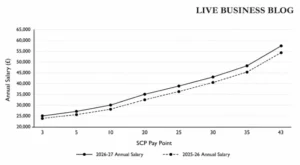
The following table shows selected pay points, using full-time annual salaries and the standard published hourly rates.
SCP 2025-26 Annual Salary 2026-27 Annual Salary Annual Increase 2026-27 Hourly Rate
3 £24,796 £25,614 £818 £13.28
5 £25,583 £26,427 £844 £13.70
10 £27,694 £28,608 £914 £14.83
20 £32,597 £33,673 £1,076 £17.45
25 £36,363 £37,563 £1,200 £19.47
30 £40,777 £42,123 £1,346 £21.83
35 £46,142 £47,665 £1,523 £24.71
43 £54,495 £56,293 £1,798 £29.18
These figures are gross. They exclude personal deductions and any separate local supplements. The annual increases shown are the differences between the published, rounded salaries.
Understanding Spinal Column Points And Local Pay Grades
A spinal column point, usually shortened to SCP, identifies a salary amount within the pay spine. A local grade groups the pay points an employer uses for a particular level of work.
Grade names and numbers can differ between councils. Comparing two jobs labelled “Grade 5” will not necessarily reveal whether their salaries match. Your SCP and actual salary provide a clearer starting point.
What Does The Deletion Of SCP 2 Mean?
SCP 2 was removed from the national pay spine from 1 April 2026. Employees previously paid on that point should check which replacement point their employer has applied.
Where an employee moves to a higher point, their overall salary change may exceed the standard percentage award. Simply multiplying their former SCP 2 salary by 3.3% may therefore produce the wrong answer.
How Much Extra Pay Will Employees Receive?
For an unchanged salary and working pattern, the basic calculation is:
Annual Gross Increase = Previous Annual Salary × 0.033
Use the published salary scale for an exact NJC figure, since annual rates are rounded.
Annual And Monthly Gross Pay Examples
The examples below use illustrative salaries rather than specific NJC pay points. They assume no promotion, increment or change in hours.
Previous Annual Salary Revised Annual Salary Annual Gross Increase Monthly Gross Increase
£25,000 £25,825 £825 £68.75
£30,000 £30,990 £990 £82.50
£40,000 £41,320 £1,320 £110.00
The monthly increase is the annual difference divided by 12. It is separate from any arrears paid when the award is first implemented.
How Is The Increase Calculated For Part-Time Employees?
Part-time employees receive the applicable percentage increase on their actual eligible pay. Their cash increase reflects their contractual hours.
For example, someone working 18.5 hours out of a 37-hour full-time week works 50% of full-time hours.
If the illustrative full-time salary rises from £30,000 to £30,990, their corresponding part-time salary rises from £15,000 to £15,495.
That produces an extra £495 gross annually, or £41.25 a month. Use your employer’s full-time hours when calculating your own proportion.
How Does The Award Affect Term-Time School Staff?
Term-time pay depends on both working hours and the employer’s paid-weeks arrangements, including the relevant holiday entitlement.
A salary advertised as full-time equivalent is not necessarily the amount a term-time employee receives.
For a simple illustration, if your actual annual basic pay is £18,000 and all of it receives the standard increase, it becomes £18,594.
That is an additional £594 gross annually, or £49.50 a month when paid in 12 equal instalments.
This assumes your hours, paid weeks and pay point stay unchanged. Payroll should calculate a revised figure if any of those factors changes.
When Will The Local Government Pay Rise And Back Pay Be Paid?
There is no single confirmed payday for every employee covered by the settlement.
Your employer should communicate when the revised rate and arrears will be processed.
The Difference Between The Effective Date And Payroll Payment Date
The effective date establishes when the higher rate applies. The payroll payment date is when your employer actually pays it.
An employee can therefore receive the increase later in the year while still being owed the difference for earlier eligible months.
Check whether your employer plans to pay arrears alongside the first revised salary or through a separate payment.
How To Calculate Back Pay From April 2026?
For an employee with unchanged monthly basic pay, a simple estimate is:
Gross Back Pay = Monthly Gross Increase × Number Of Unpaid Months
Using the £30,000 salary example, the monthly increase is £82.50.
If an employer first applies the new rate in September and owes the difference for April to August, the calculation is:
£82.50 × 5 = £412.50 Gross Back Pay
September’s regular salary would already include the new rate, so it should not also be counted as an unpaid month in this example.
This is an illustration, not a confirmed September payment schedule. Partial months, allowances and other adjustments require a more detailed calculation.
What Happens If You Joined, Left Or Changed Hours During The Year?
Someone who joined after 1 April should have the applicable revised rate calculated from their relevant employment start date.
They would not receive salary arrears for a period before they worked there.
If you changed hours or received a promotion, payroll should calculate the difference separately for each period.
Applying your latest hours to the entire arrears period can produce an incorrect result.
Former employees should contact their previous employer about outstanding arrears.
Guidance for parish and town councils recommends paying relevant amounts from April until the leaving date when a former employee requests them.
Ask how your own employer handles leavers, rather than assuming payment will arrive automatically.

How Will The Pay Rise Affect Take-Home Pay And Benefits?
The gross increase is not necessarily the amount added to your bank balance.
Personal deductions and household circumstances determine the final effect.
Income Tax, National Insurance And Pension Deductions
The additional salary and arrears are normally subject to the relevant payroll deductions.
These can include Income Tax, National Insurance, pension contributions and student loan repayments where applicable.
Your tax code, earnings level and pension arrangements influence the result.
Pensionable salary increases can also increase the amount contributed to the Local Government Pension Scheme.
A large arrears payment can make one payslip look unusual. Compare gross pay and each deduction separately before assuming the award has been calculated incorrectly.
How Higher Earnings And Back Pay Can Affect Universal Credit?
Universal Credit depends partly on earnings received during each assessment period.
A back-pay payment can increase the earnings taken into account and may reduce that period’s benefit payment.
The effect depends on your household circumstances, including any work allowance.
Understanding how earnings affect Universal Credit can help you compare the higher payslip with your benefit statement.
Check that the earnings reported match what you received. If something appears wrong, raise it through your Universal Credit account and ask payroll to check the information submitted.
What Should You Do If Your Pay Rise Or Back Pay Is Missing?
First, check whether your employer has announced an implementation date.
If the relevant payday has passed, gather your latest payslip and any notice confirming the award.
- Check Your Salary: Compare your revised pay point and actual contractual salary with the appropriate scale
- Review The Arrears Period: Confirm the starting date, unpaid months and any employment changes
- Request A Breakdown: Ask payroll to separate basic-pay arrears, allowances and deductions
- Follow-Up In Writing: Contact HR or your union representative if the explanation does not resolve the issue
Include your employee number, relevant dates and the figure you believe needs checking. A specific query is easier to investigate than a general statement that your pay looks too low.
Conclusion
The local government pay rise for 2026-27 is agreed, and employees should now focus on their revised salary and outstanding back pay. Check the pay framework covering your role, your current SCP and your employer’s payment notice.
Part-time hours, term-time arrangements, increments and changes of employment can all affect the calculation.
Once the award appears on your payslip, compare the gross figures and deductions separately to understand what you have received.
Frequently Asked Questions
Is The Local Government Pay Rise For 2026-27 A Permanent Salary Increase?
Yes. The agreed percentage is consolidated into the relevant salary rates. Back pay is the separate amount owed for the period before those rates were implemented.
Will Employees Receive The Original £3,000 Or 10% Pay Claim?
No. Those figures formed part of the original union demand. The accepted settlement provides the percentage increase reflected in the published 2026-27 pay scales.
Do Employees Need To Be Union Members To Receive The Award?
No. Collective pay agreements can cover employees who are not union members. Eligibility depends on the employment arrangements applying to the role.
Does The Pay Award Replace An Annual Pay Increment?
The award changes salary rates, while an increment moves an eligible employee between pay points.
They are separate processes, and any incremental progression depends on the employer’s grading and contractual rules.
Are Allowances Included In The Pay Rise?
The settlement includes a 3.3% increase to the allowances specified in the national agreement.
A locally determined supplement should be checked separately rather than assumed to receive the same treatment.
Can An Employer Choose Not To Apply The NJC Award?
An employer’s obligations depend on the contract and applicable collective arrangements.
Where an employee has a contractual entitlement to an increase and meets the relevant conditions, it should be paid.
Ask HR or a union representative to clarify any dispute about coverage.
