

The £200 Cost of Living Payment is not a new nationwide £200 payment from the Department for Work and Pensions in 2026/27.
As of August 2026, some households in England can receive £200 or another amount from their local council through the Crisis and Resilience Fund, depending on where they live and their financial circumstances.
The Crisis and Resilience Fund launched on 1 April 2026 and runs until 31 March 2029. The Government has described it as a £1 billion fund for local authorities in England, replacing the Household Support Fund and incorporating support previously provided through Discretionary Housing Payments.
There is still no nationwide entitlement to £200. Councils determine how their local schemes operate, and payment amounts, eligibility criteria and application requirements can differ between areas.
The previous Household Support Fund remains relevant historically. During 2025/26, £742 million was made available to English local authorities through the HSF, which ran from 1 April 2025 to 31 March 2026.
This means older reports about a “£200 Cost of Living Payment” may refer to expired Household Support Fund schemes, while current £200 payments are more likely to be locally determined Crisis Payments under the Crisis and Resilience Fund.
What Was the £200 Cost of Living Payment?

The term £200 Cost of Living Payment did not refer to a universal £200 benefit created by the DWP for everyone receiving Universal Credit, Pension Credit, PIP or another benefit.
Instead, several councils used part of their Household Support Fund allocation to offer one-off payments or vouchers worth £200 to particular groups facing financial hardship.
The Household Support Fund’s primary purpose was to provide crisis assistance to vulnerable households struggling with essential costs.
Councils could use it for food, energy, water and other essential bills, as well as some wider essential costs and certain housing-related needs. Support could be delivered as cash, vouchers or goods.
The distinction matters because claims online that everyone on benefits was automatically entitled to a new £200 DWP payment were misleading.
Was There a Nationwide £200 DWP Payment in 2025/26?
No single nationwide £200 DWP Cost of Living Payment applied to all eligible benefit claimants during 2025/26.
The £200 figures reported by individual councils came from locally designed support schemes.
The Government gave councils flexibility to determine their own eligibility criteria and award amounts within the Household Support Fund framework.
That differs from previous national Cost of Living Payments, where qualifying benefits and payment dates were established centrally.
Readers researching broader support should therefore distinguish local grants from national cost of living payments, because the eligibility and payment mechanisms can be very different.
Who Could Get a £200 Local Council Payment in 2025/26?
There was no single national eligibility test.
Government guidance stated that the Household Support Fund was intended to reach a broad range of low-income households and was not restricted to people receiving benefits.
Councils were allowed to establish their own local criteria.
Potential recipients could therefore include:
- low-income working households;
- Universal Credit claimants;
- pensioners;
- disabled people and households containing a disabled person;
- families with children;
- unpaid carers;
- care leavers;
- single-person households;
- households facing unexpectedly high essential costs; and
- people experiencing a sudden financial shock.
Receiving one of these payments was never guaranteed simply because somebody belonged to one of these groups. The relevant council’s eligibility rules still had to be satisfied.
Benefits Were Not Always Required
One of the most important Household Support Fund rules was that councils should not restrict support solely to people receiving means-tested benefits.
Government guidance specifically stated that the fund was intended for a wide range of low-income households and that councils did not necessarily have to conduct a formal means test unless this formed part of their local policy.
Someone who was working, for example, could therefore potentially qualify where their income was insufficient to meet essential household expenditure.
Financial Hardship Was Usually Central
Although councils designed different tests, financial need was normally the underlying requirement.
That could mean difficulty paying for essentials such as:
- groceries;
- gas or electricity;
- water;
- heating oil;
- essential household equipment;
- necessary clothing;
- essential transport; or
- urgent housing-related costs in limited circumstances.
Government guidance specifically permitted support with essentials and certain wider necessities, including one-off payments intended to stop a household falling into crisis.
How £200 Council Payment Rules Differed Across England?

Real council schemes illustrate why there was no universal definition of who qualified for the £200 Cost of Living Payment.
| Council example | £200 support | Example eligibility or payment structure |
|---|---|---|
| Ribble Valley | £200 voucher | Single-person households with combined household income below £35,000 could potentially qualify |
| Newcastle upon Tyne | £200 payment | Main householder experiencing a budget deficit and referred through an approved advice partner |
| Reading | £200 payment | Low-income residents meeting local financial criteria, including savings rules |
| Cheshire East from 2026/27 | £200 payment | Current Crisis and Resilience Fund can provide £200 crisis support following a short-term financial emergency |
These examples should not be treated as national eligibility rules.
Ribble Valley £200 Payment
Ribble Valley Borough Council opened its 2025/26 Household Support Fund scheme to households with a combined annual income below £35,000.
Its award structure was:
- £200 for single households
- £300 for households with two or more adults
- £500 for households with children
Only one application could be made per household, and payments were available while funding lasted.
This provides a clear example of why describing the scheme simply as a nationwide “£200 payment” could be inaccurate. £200 was only one level within that particular council’s local scheme.
Newcastle £200 Household Support Payment
Newcastle City Council operated another form of £200 assistance.
Its scheme offered £200 per household, rising to £300 where Child Benefit was received for somebody living in the household.
Eligibility required the person to be a Newcastle resident, be responsible for household bills and have a deficit in their household budget.
Applicants also needed assistance from an approved advice organisation, which could make a referral to the fund. Residents could not simply self-refer directly under that particular arrangement.
Again, these were Newcastle’s rules—not UK-wide requirements.
Reading £200 Cost of Living Payment
Reading Borough Council also opened a £200 Household Support Fund payment during January 2026.
Households receiving income-based benefits were treated as low-income for the purposes of the local scheme.
People who did not receive income-based or state benefits could still be considered following an assessment of income, essential expenditure and savings.
Reading specified that applicants with more than £2,000 in savings were not eligible for that particular round.
This savings threshold was a Reading rule and should not be applied to Household Support Fund schemes elsewhere.
For comparison, other means-tested assistance can operate under entirely different capital rules.
The separate Housing Benefit savings limit should therefore not be assumed to determine eligibility for a local hardship grant.
Did Universal Credit Claimants Automatically Get £200?
Not necessarily.
Receiving Universal Credit could help a council identify a household as being on a low income, but there was no national rule saying every Universal Credit claimant would receive £200.
Government guidance allowed councils to use DWP information relating to Universal Credit, Pension Credit, income-related Employment and Support Allowance and Housing Benefit to identify potentially vulnerable households.
However, it explicitly stated that benefit entitlement itself was not a condition for Household Support Fund assistance.
Some councils made automatic awards using existing records. Others required applications or referrals.
Could Pensioners Qualify for £200?
Yes, pensioners were among the groups councils were encouraged to consider.
The Government’s 2025/26 guidance specifically identified pensioners alongside families, disabled people, carers, care leavers and single-person households as groups that could fall within the broad population intended to benefit from the fund.
However, simply being above State Pension age did not establish a national right to £200.
Some councils targeted support at pensioners with particular benefits or low incomes, while others used their allocation differently.
A pensioner therefore needed to check the scheme operated by their own local authority rather than relying on eligibility rules reported for another council.
Could Someone Get £200 Without Receiving Benefits?
Potentially, yes.
The Household Support Fund was deliberately designed to reach some households that were struggling despite not receiving means-tested benefits.
Government guidance stated clearly that HSF eligibility was not limited to benefit recipients and encouraged councils to use other information and referrals to identify households facing hardship.
A working household whose wages were insufficient to cover essential bills could therefore potentially have received assistance if it satisfied the relevant council’s rules.
This was particularly important for households whose income was above normal benefit thresholds but which had unusually high essential expenditure or experienced an unexpected financial shock.
What Could the Household Support Fund Be Used For?

The fund was intended primarily for essential living costs.
Government guidance allowed councils to provide immediate crisis assistance with food, energy and water.
Wider support could include phone or broadband bills, essential clothing, hygiene products and necessary transport costs.
Councils could also provide items designed to reduce future household expenditure, including energy-efficient appliances and certain essential white goods.
Housing costs could be supported in some circumstances, although existing routes such as Universal Credit housing support, Housing Benefit and other housing assistance generally had to be considered first.
The HSF could not ordinarily be used to pay a homeowner’s mortgage, although homeowners could still potentially qualify for help with food, utilities or other eligible essentials.
Did People Need to Apply for the £200 Payment?
It depended on the council.
DWP guidance allowed Household Support Fund assistance to be distributed through several routes, including:
- identifying eligible households automatically;
- accepting direct applications;
- using third-party organisations;
- accepting professional referrals; or
- combining several approaches.
Every authority was required to make at least some support accessible through an application-based route, although that application could sometimes be handled by a third-party organisation rather than the council itself.
This explains why some households received vouchers or payments without applying while others had to complete a financial assessment.
What Evidence Could Councils Ask For?
Evidence requirements were determined locally.
Depending on the scheme, applicants could have been asked for information about household income, benefits, savings, expenditure and essential bills.
For example, Newcastle advised applicants to bring information such as wage slips, benefit letters, bank statements and details of household spending when completing the financial assessment required under its scheme.
Applicants should therefore never assume that one council’s documentation requirements applied elsewhere.
Was the £200 Payment Available Across the Whole UK?

Not under the same Household Support Fund arrangements.
The 2025/26 Household Support Fund guidance applied to England.
Other parts of the UK operate different systems.
In Scotland, the Scottish Welfare Fund includes Crisis Grants for people on low incomes experiencing emergencies and Community Care Grants designed to support independent living.
Applications are made through local councils.
Wales operates the Discretionary Assistance Fund, which can provide emergency help towards essentials such as food, gas, electricity, heating oil and emergency travel for people experiencing severe financial hardship.
Northern Ireland has Discretionary Support, which may provide loans or grants in exceptional or crisis situations for essential living expenses and household items.
There is therefore no single UK-wide £200 local council grant with identical eligibility rules.
Is the £200 Cost of Living Payment Still Available in 2026?
Yes, £200 local crisis payments are still available in some parts of England in 2026, but there is no nationwide £200 payment available to everyone.
The Household Support Fund ended on 31 March 2026. From 1 April 2026, it was replaced by the Crisis and Resilience Fund, which is scheduled to operate until 31 March 2029.
Under the new system, every relevant county council and unitary authority must operate a Crisis Payment scheme. Government guidance says these schemes should primarily be application-based, use a cash-first approach and aim to remain available throughout the year.
However, the Government has not set £200 as the national payment amount. Councils retain discretion over their schemes and assess local need.
A current example is Cheshire East Council, where eligible residents can apply for one £200 crisis payment per household between 20 April 2026 and 31 March 2027.
The payment is intended for households experiencing a short-term financial emergency or unexpected reduction in income.
Therefore, someone searching for a £200 Cost of Living Payment in 2026 should check their own council’s Crisis and Resilience Fund rather than assuming the Cheshire East payment or any other council’s award applies nationally.
How Can Someone Check What Their Council Currently Offers?
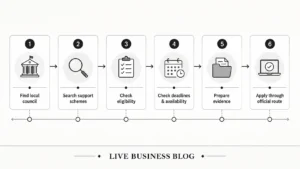
Someone looking for financial help in England in 2026 should search for their council’s Crisis and Resilience Fund or Crisis Payment, rather than relying on old Household Support Fund pages.
GOV.UK currently confirms that the Crisis and Resilience Fund can help with costs such as food, energy and water bills, essential items and housing costs.
People do not necessarily have to be receiving benefits to qualify, and receiving a Crisis and Resilience Fund payment does not affect existing benefit payments.
Councils determine how their individual schemes operate, so eligibility criteria, award values and application procedures can differ significantly between areas.
A useful process is to:
- Find the correct local authority through GOV.UK
- Search its website for “Crisis and Resilience Fund” or “Crisis Payment”
- Check whether applications are currently open
- Read the council’s income, savings and residency requirements
- Check how many applications are permitted per household
- Prepare evidence such as income details, bank statements, savings information and essential expenditure where requested
- Apply through the council or an organisation officially authorised to administer the scheme
Government guidance requires authorities to operate Crisis Payment schemes and says applications should be accepted throughout the year, although individual eligibility and awards remain locally determined.
Watch for Misleading £200 Payment Claims
Cost of living payments frequently attract misleading social media posts, unofficial adverts and phishing messages.
A claim such as “everyone on Universal Credit can now claim £200” should not be accepted without checking the official eligibility criteria.
Legitimate council schemes may request financial information as part of an application, but applicants should use the council’s official website or an organisation explicitly authorised by the council.
A genuine local grant should not require somebody to pay a fee simply to release their payment.
Key Facts About the £200 Cost of Living Payment
The most important points are straightforward.
The £200 payment was not one universal DWP benefit. During 2025/26, several councils offered payments or vouchers around £200 using money from the Household Support Fund.
Eligibility depended on where the household lived. Councils could set their own income limits, savings rules, household criteria and application processes.
Benefits were not always required. The national HSF framework specifically allowed councils to support low-income households that were not receiving benefits.
£200 was not a fixed national award. Councils could provide larger or smaller awards according to household circumstances.
The 2025/26 HSF has now ended. It ran from 1 April 2025 to 31 March 2026.
Current applicants in England should check the Crisis and Resilience Fund. This replaced the Household Support Fund from April 2026 and can still include locally determined crisis payments.
Final Word
The 200 Pound Cost of Living Payment should not be understood as a guaranteed £200 payment for every UK household or every person receiving benefits.
During 2025/26, the figure commonly referred to locally was generally connected with council-run Household Support Fund schemes.
The Government provided £742 million for English councils to support vulnerable households, but councils retained discretion over eligibility, award values and application arrangements.
That produced significant differences between areas.
One council might have offered a £200 cash payment, another a supermarket or energy voucher, while another could have targeted its funding at entirely different groups.
Because the Household Support Fund ended on 31 March 2026, anyone seeking help now should check the current support offered by their local authority under the Crisis and Resilience Fund or another local welfare scheme.
A current council webpage should always take precedence over old social media posts or reports referring to 2025/26 eligibility.
Frequently Asked Questions
Is everyone on Universal Credit getting a £200 Cost of Living Payment?
No. There was no national rule giving every Universal Credit claimant an automatic £200 payment in 2025/26. Some councils offered £200 through local Household Support Fund schemes with their own eligibility rules.
Is the £200 payment from the DWP?
The central Government funded the Household Support Fund through the DWP, but councils decided how local HSF assistance was distributed.
A council’s £200 award was therefore different from a nationally standardised DWP Cost of Living Payment.
Can working people qualify for local cost of living support?
Yes, potentially. Household Support Fund guidance was not restricted to benefit claimants, meaning low-income working households could qualify where they met their council’s criteria.
Do pensioners automatically receive the £200 payment?
No. Pensioners were one of the groups councils could support, but there was no universal £200 entitlement based solely on age. Local eligibility rules determined whether a payment was made.
Can a household receive more than £200?
Yes. Councils determined their own award values. For example, Ribble Valley’s 2025/26 scheme provided £200 for single households, £300 for households with two or more adults and £500 for qualifying households with children.
Can someone apply for the 2025/26 Household Support Fund now?
The national 2025/26 funding period ended on 31 March 2026, so new applicants should check what replacement support is currently available through their council.
What replaced the Household Support Fund?
In England, the Crisis and Resilience Fund replaced the previous Household Support Fund arrangements from 1 April 2026 and is scheduled to operate through March 2029.
Local councils continue to decide how much support individual households can receive.

Leave a Reply