
Last Updated on AUG 18, 2026
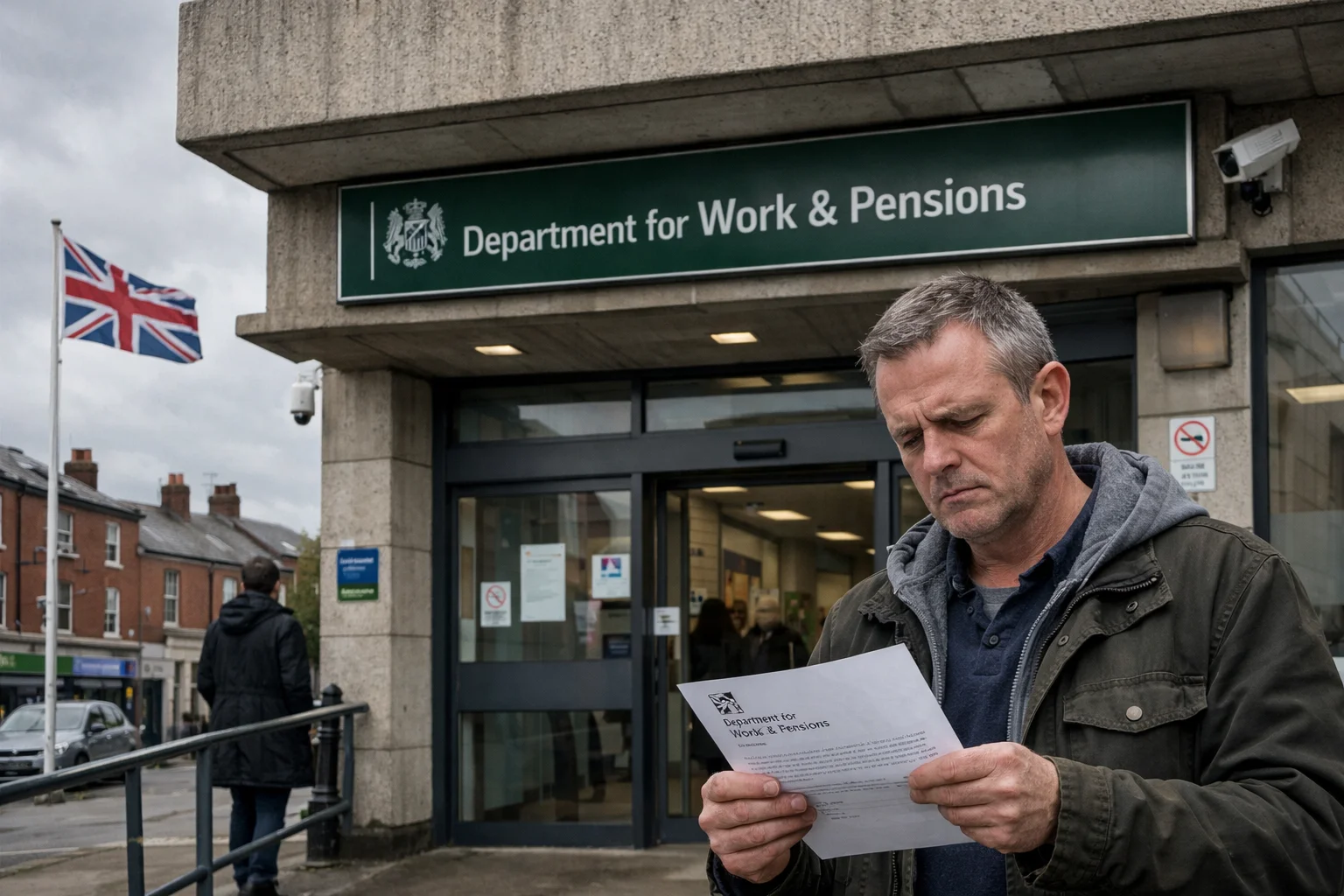
A PIP payment can sometimes be suspended or cease before a claimant physically receives a letter, but this is different from the DWP making a final decision without notifying them.
Current DWP guidance states that when a decision is made about PIP entitlement, the claimant is sent a decision letter explaining the outcome.
However, payment can be suspended in certain circumstances without the DWP contacting the claimant beforehand, and the notification may therefore be received after the payment issue has already become apparent.
A fixed-term award can also reach its stated end date, although current rules now give the DWP additional powers to extend some fixed-term PIP awards for administrative reasons.
Therefore, “PIP stopped before I received a letter” does not necessarily mean the DWP made the decision without any notification at all.
Key scenarios include:
- Not returning the “How your disability affects you” form
- Missing a medical assessment without good cause
- End of award with no renewal processed
- Administrative suspension during investigations
Understanding the difference between a suspension, reduction, or full termination is essential. If PIP stops, claimants should contact the DWP immediately and may request a Mandatory Reconsideration or appeal to an independent tribunal.
Can the DWP Stop PIP Without Sending a Letter First?
The Department for Work and Pensions follows defined procedures when stopping or changing Personal Independence Payment, but written notification does not always arrive before payments cease.
Under Personal Independence Payment PIP regulations, the DWP is generally required to issue a decision notice when entitlement changes.
However, payment systems can stop automatically in certain circumstances where eligibility is no longer met or claimant action is missing.
PIP is not discretionary. It is governed by the Social Security (Personal Independence Payment) Regulations 2013.
These regulations allow the DWP to suspend or terminate payments when specific legal conditions apply.
In practice, most claimants who experience an unexpected stop later discover that the DWP had already attempted contact, or that their award legally ended.
Written notification is still required for the decision itself, but the timing matters. In some cases, payments stop first and the letter follows later.
This distinction often causes confusion and distress for claimants who believe PIP has been stopped without notice when the decision was already valid under benefit law.
The most important factor is whether the claimant was under a legal duty to act and did not do so.
When that happens, the DWP does not need prior consent or confirmation to stop payments.
In What Situations Can PIP Be Stopped Without Warning?

There are specific scenarios where PIP can lawfully stop with little or no advance notice. These situations are based on eligibility rules rather than discretionary decisions.
Fixed Term Awards Reaching Their End Date
Fixed-term PIP awards have an end date, which should be shown on the claimant’s award letter. Where an award also has a planned review date, the DWP normally starts the award review before the existing award ends.
Current GOV.UK guidance states that claimants continue receiving PIP while their claim is being reviewed. For a planned fixed-term award review, the DWP normally issues an AR1 review form.
There is also an important change from 2 June 2026. The DWP now has a specific power to extend the length of a fixed-term PIP award when this is considered necessary to protect the efficient administration of PIP.
Examples given in DWP guidance include serious backlogs, resource limitations, system outages and national emergencies.
An administrative extension changes the length of the award but does not itself change the amount of PIP being paid.
Claimants should therefore not assume that an award will automatically stop simply because the original end date is approaching while a DWP review remains outstanding.
Failure to Return Review Forms
For an existing PIP award review, the DWP normally uses the AR1 award review form. The PIP2 ‘How your disability affects you’ questionnaire is primarily associated with the PIP claim process and should not be treated as interchangeable with the AR1.
If the form is not returned, the DWP treats this as a failure to engage with the review process.
In these cases:
- Payments can stop without a final warning letter
- The DWP assumes entitlement cannot be confirmed
- The decision is administrative rather than medical
This applies equally to physical and mental health claimants.
Missed Assessments Without Good Reason
If a claimant does not attend a scheduled assessment and does not provide a valid reason, the DWP can end the award.
Assessment providers report non-attendance directly to the DWP, triggering a stop.
Good reasons include hospitalisation, severe illness, or emergencies, but these must be communicated promptly.
If the DWP does not receive this information in time, payment may stop before the claimant is aware of the decision.
Hospital or Care Home Stays Over 28 Days
Hospital and care-home rules differ depending on the circumstances and how the claimant’s care is funded.
For an adult PIP claimant who is an NHS hospital inpatient, both the daily living and mobility components can stop being payable after 28 days, subject to the detailed linking and hospital rules.
Care homes are different. Where a care-home placement is publicly funded, the daily living component can normally be affected after 28 days, while the mobility component may continue in some circumstances.
A claimant who fully pays for their own care-home placement may be able to continue receiving both parts of PIP.
Claimants should report hospital and care-home stays promptly because previous stays can also be relevant when the DWP calculates the 28-day period.
Extended Absence From Great Britain
PIP eligibility requires ordinary residence in Great Britain. If a claimant leaves the country for more than:
- 13 weeks generally
- 26 weeks for approved medical treatment
payments can stop. Again, prior notification depends on whether the claimant reported the absence.
Administrative Suspensions During Investigations
In rare cases, payments may be temporarily suspended during investigations into entitlement or accuracy of information.
This does not automatically mean fraud, but payments may pause while checks are carried out.
When Will the DWP Notify You Before Stopping PIP?
Despite the situations above, most PIP changes are accompanied by written notification. Decision letters explain the outcome, reasons, and appeal rights.
Claimants should expect notification in these circumstances:
- After a completed assessment
- Following a paper based review
- When a change of circumstances is reported
- When an award is reduced rather than stopped
- When an investigation formally begins
Notification letters are usually sent by post. Delays can occur due to address issues, postal disruption, or processing backlogs.
The legal requirement is that a decision notice is issued, not that it arrives before the payment date.
What Is the Difference Between Suspension, Reduction, and Termination of PIP?
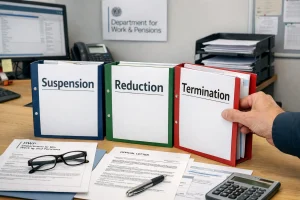
Understanding the type of action taken by the DWP is essential because each has different consequences and rights.
| Action Type | What It Means | Payment Status | Challenge Rights |
|---|---|---|---|
| Suspension | Payment is temporarily withheld while an issue about entitlement or information is resolved | Paused | No ordinary right of appeal against the suspension itself; claimant can ask DWP to reconsider or lift it |
| Reduction | PIP continues but at a lower rate following an entitlement decision | Reduced | Normally challenge through Mandatory Reconsideration and then tribunal |
| Termination | The PIP award is formally ended | Stopped | Normally challenge through Mandatory Reconsideration and then tribunal |
A suspension does not necessarily mean the underlying PIP entitlement has ended. If the issue is resolved and the suspension is lifted without the award being revised or terminated, DWP guidance provides for payments to be reinstated and any arrears due to be paid.
How Are PIP Decisions Made by the DWP?
PIP decisions follow a structured process involving evidence gathering, assessment, and legal criteria.
Evidence Considered
The DWP bases decisions on:
- Claimant statements
- Medical evidence from GPs or specialists
- Assessment reports from health professionals
- Supporting letters from carers or support workers
There is no automatic entitlement based on diagnosis alone. Decisions focus on how a condition affects daily living and mobility activities under the PIP descriptor system.
Assessment Routes
Not all claimants attend assessments. Decisions may be made through:
- Paper based reviews where evidence is sufficient
- Telephone assessments
- Video assessments
- Face to face assessments
Failure to engage with the required assessment route can result in payment stoppage.
Decision Making and Reviews
A DWP decision maker reviews all available evidence and applies the legal descriptors. Reviews can result in:
- Award continuation
- Award reduction
- Award termination
Claimants must be notified of the outcome and given appeal rights.
What Should You Do If Your PIP Is Stopped Without Notice?

Immediate action is critical if payments stop unexpectedly.
First, the claimant should confirm whether the stop is due to:
- Award end date
- Missed correspondence
- Assessment non-attendance
- Administrative suspension
Contacting the DWP PIP enquiry line is the fastest way to identify the reason.
Steps that should be taken include:
- Checking all recent post carefully
- Confirming contact details with the DWP
- Asking whether the decision is a suspension or termination
- Requesting written confirmation if none has been received
If the stop is due to non-returned forms or missed assessments, reinstatement may be possible if the claimant acts quickly and provides a valid reason.
How Can a PIP Decision Be Challenged?
All PIP decisions carry appeal rights. The process is structured and time limited.
Mandatory Reconsideration
-
For most PIP entitlement decisions, requesting a Mandatory Reconsideration is the normal first stage before an appeal to an independent tribunal.
A claimant should normally request Mandatory Reconsideration within one month of the date on the decision letter. However, the one-month period is not an absolute cut-off.
-
GOV.UK states that a late Mandatory Reconsideration request can still be made where the claimant has a good reason for the delay, although they must explain why the request is late.
-
The claimant should explain which part of the PIP decision they believe is wrong and can provide relevant new supporting evidence.
After the Mandatory Reconsideration has been completed, the DWP sends a Mandatory Reconsideration Notice. If the claimant still disagrees, they can normally appeal to the Social Security and Child Support Tribunal within one month of the date on that notice.
Some benefit decisions follow different challenge procedures, so claimants should always check the instructions contained in their individual decision letter.
Appeal to an Independent Tribunal
If the Mandatory Reconsideration is unsuccessful, the claimant can appeal to the Social Security and Child Support Tribunal, administered by HM Courts and Tribunals Service.
Tribunals are independent of the DWP and can:
- Reinstate awards
- Increase rates
- Backdate payments
Success rates are significantly higher for claimants who attend hearings and provide supporting evidence.
What Support Is Available If PIP Is Stopped?
Claimants do not need to manage this process alone. Several official and charitable bodies provide assistance.
Support can be accessed through:
- Citizens Advice for benefit guidance and appeals
- Local council welfare rights teams
- Disability Rights UK for entitlement advice
- Law centres for complex cases
Local councils may also provide temporary financial support or hardship assistance while appeals are ongoing.
Real-Time Example: PIP Stopped Due to Missed Review Form

James, a 48-year-old claimant from Manchester, had been receiving PIP for a long-term mobility condition.
His award was due for routine review in mid-2025, and the Department for Work and Pensions (DWP) sent him the “How your disability affects you” (AR1) form with a return deadline of 35 days.
Due to ongoing mental health challenges and changes in his support arrangements, James missed the deadline and did not return the form on time.
He did not inform the DWP or request an extension. Two weeks later, he noticed that his PIP payment had not arrived.
Upon contacting the DWP, James was informed that his PIP had been stopped because the form was not returned.
The DWP had issued a decision notice by post, but James had not opened the letter.
He was advised to request a Mandatory Reconsideration within one month and explain the reason for the missed form.
With help from his local council’s welfare rights team, James submitted a late AR1 form along with a supporting letter from his GP.
The DWP accepted his explanation and reinstated his payments following the reconsideration, backdating the missed payment.
This case highlights how PIP can stop without prior warning if a claimant fails to act, but also shows that proactive engagement and support can lead to a positive resolution.
Common Scenarios Where PIP May Stop Without Immediate Notification
| Situation | Likelihood of Prior Notice | Main Cause | Possible Resolution |
| Fixed term award end | Low | Award expired | Request review or reapply |
| Missed assessment | Low | Non-attendance | Provide good reason |
| Review form not returned | Low | No response | Submit form urgently |
| Hospital stay over 28 days | Low | Change in eligibility | Notify DWP |
| Investigation | Limited | Verification process | Cooperate and seek advice |
Summary: Know Your Rights if Your PIP Is Stopped
PIP can be stopped without prior notification in certain conditions, such as missed assessments, unreturned review forms, or the end of a fixed-term award.
However, in most cases, the DWP is expected to provide written notice of any change to your award.
Understanding the reasons behind sudden changes, knowing your rights, and seeking help promptly can prevent unnecessary stress and ensure your income is protected.
Always keep your information updated and respond quickly to DWP correspondence.
FAQs About PIP Being Stopped
How long can PIP be stopped without notification?
PIP may stop immediately in cases like missed assessments or unreturned forms. The DWP may not issue prior notice in such cases, but you will typically receive follow-up confirmation by post.
My PIP has been stopped – what can I do now?
First, contact the DWP to clarify why it stopped. If you disagree, you can request a Mandatory Reconsideration within one month of the decision.
Why has my PIP stopped without notice?
This could result from administrative reasons, missed communications, or eligibility changes. Common causes include not responding to forms or appointments.
Can PIP stop without notification for mental health claimants?
Yes. The rules apply equally to all claimants, regardless of the condition. If assessments or forms are missed, payments may be stopped.
What’s the difference between PIP stopping and being reduced?
Stopping means your award ends entirely. A reduction indicates your entitlement level has decreased. Both can be challenged.
I didn’t get a letter – is there a problem with PIP payments today?
Occasionally, payment delays occur. Check your post, contact the DWP, and monitor official channels for service updates.
What’s the PIP contact number if my payment stopped?
You can call the DWP Personal Independence Payment enquiry line on 0800 121 4433 (Monday to Friday, 9am to 5pm).

Leave a Reply